

Natural Non Greasy Muscle Recovery Cream Guide
Table of Contents
- Why a Non-Greasy Muscle Cream Changes Your Recovery Routine
- How to Soothe Sore Muscles Naturally After Workouts
- Best Essential Oils for Muscle Recovery and How They Work
- How to Apply Muscle Recovery Cream for Better Absorption
- Cooling vs Warming: Choosing the Right Sensation
- Sensitive Skin, Sustainability, and Layering with Other Recovery Tools
- Comparing Natural Non Greasy Muscle Creams from Healthy Embraces
- Conclusion: Building a Consistent Recovery Habit
- Frequently Asked Questions
Last Updated: September 16, 2026
Why a Non-Greasy Muscle Cream Changes Your Recovery Routine
A natural non greasy muscle recovery cream is a topical formula built on plant-based ingredients that absorbs without the heavy, slippery film most drugstore balms leave behind, which is exactly what a natural non greasy muscle recovery cream should do. At Healthy Embraces, we hear the same complaint constantly: people want relief for tight shoulders and tired legs without smelling like menthol or staining their work shirts. That trade-off is no longer unavoidable.
The difference comes down to the base, not the actives. Most greasy balms rely on petrolatum, mineral oil, or heavy waxes that sit on top of the skin for hours. A cream built on lighter botanical carriers absorbs within minutes, so you can apply it before a meeting, before bed, or under a fitted shirt. The ingredients still reach the muscle tissue; they simply do not linger.
Below, we break down how to soothe sore muscles naturally, which essential oils actually work, how to apply muscle recovery cream for real absorption, and how to pick between cooling and warming formulas.
How to Soothe Sore Muscles Naturally After Workouts
The most effective natural recovery routine combines four things: gentle movement, hydration, sleep, and a topical cream applied to the right areas at the right time.
Delayed onset muscle soreness, or DOMS, peaks a day or two after hard training. It is not a sign of damage; it is the normal inflammatory response to unfamiliar load. Many athletes find light active recovery, a walk, a swim, or easy cycling, reduces stiffness faster than complete rest.
Here is the sequence that tends to work best:
- Cool down properly after training, five to ten minutes of easy movement
- Rehydrate, since dehydration worsens the sensation of muscle fatigue
- Apply a topical analgesic to the areas that worked hardest, within an hour of finishing
- Get consistent sleep, which is when most tissue repair actually happens
A common mistake is waiting until soreness peaks. Applying a cream early, while the tissue is still warm from activity, feels more effective than chasing the pain two days later.
Best Essential Oils for Muscle Recovery and How They Work
The best essential oils for muscle recovery are peppermint, eucalyptus, lavender, wintergreen, and frankincense, each working through a slightly different mechanism. Peppermint and eucalyptus deliver the familiar cooling sensation. Wintergreen and birch contain salicylates, the plant compounds behind that warming effect. Lavender supports relaxation rather than physical sensation.
What most guides miss is that concentration matters more than the ingredient list. A cream can name ten oils and do very little if the blend is mostly filler. Therapeutic grade oils at meaningful percentages separate a formula that produces a noticeable sensation from one that smells nice and disappears.
National Center for Complementary and Integrative Health overview of aromatherapy and essential oils notes that essential oils are concentrated plant extracts and should be used with care, particularly on sensitive skin. That is why dilution in a proper cream base matters.
How to Apply Muscle Recovery Cream for Better Absorption
Apply muscle recovery cream to clean, dry skin and massage it in with firm, circular pressure for at least 30 seconds per area. Friction warms the skin and supports transdermal absorption, so the actives cross the skin barrier rather than sitting on top.
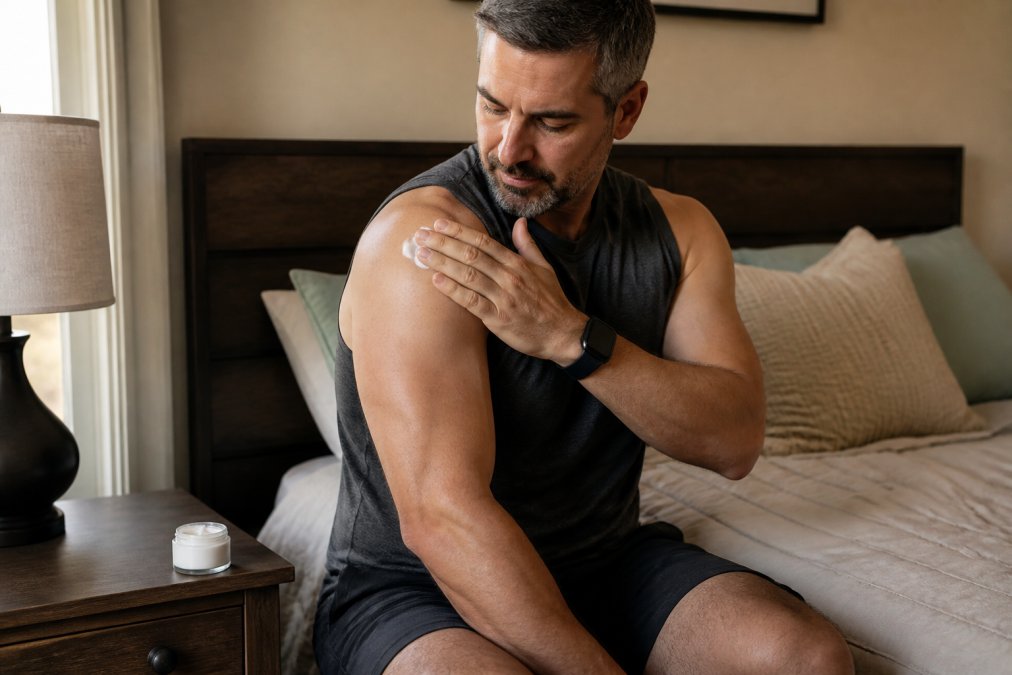
A short routine that works:
- Shower first if you can. Clean skin absorbs better than skin covered in sweat and sunscreen.
- Warm a small amount between your palms. A pea-sized amount covers a shoulder; do not over-apply.
- Work it in with the grain of the muscle, moving toward the heart.
- Give it two to three minutes before dressing. Most non-greasy formulas are dry by then.
- Reapply up to three times daily, or as needed.
Cooling vs Warming: Choosing the Right Sensation
Cooling formulas suit fresh soreness, warm or swollen areas, and daytime use, while warming formulas suit stiff, tight muscles and cold-weather recovery. The sensation is not a measure of how well the product works, but the mechanism tells you when to reach for which formula.
Cooling comes primarily from menthol and camphor, found in peppermint and eucalyptus. Warming comes from capsaicin and salicylates, found in black pepper, wintergreen, and birch. Some formulas, including several in the Healthy Embraces range, combine both, producing a warming-then-cooling effect many people find more satisfying than either alone.
What is actually happening under the skin
Menthol does not lower tissue temperature.
Matching the formula to the moment
| Sensation | Key Actives | Mechanism | Onset | Best For |
|---|---|---|---|---|
| Cooling | Menthol, camphor, eucalyptus | TRPM8 cold-receptor activation | 1-5 minutes | Fresh soreness, warm joints, daytime |
| Warming | Capsaicin, methyl salicylate, black pepper | TRPV1 activation and prostaglandin interference | 5-20 minutes, builds over uses | Stiffness, tight muscles, cold weather |
| Combined | Both, layered in one formula | Sequential receptor activation | Cooling first, warming after | General recovery, overworked areas |
Sensitive Skin, Sustainability, and Layering with Other Recovery Tools
This is where most "natural" creams quietly fail.
Sensitive skin: a real patch-test protocol
A patch test that actually tells you something:
- Apply a pea-sized amount to the inner forearm, not the wrist, and not the area you plan to treat.
- Leave it uncovered for 24 hours. Do not wash it off early, even if it tingles. Tingling is expected; burning, redness, or a raised rash is not.
- If the first 24 hours are clean, reapply to the same spot and wait another 24 hours. Some reactions are delayed and only appear on the second exposure.
- Only then apply to the treatment area, and start with half the amount you think you need.
Sustainability and sourcing: what the label does not tell you
- Cruelty-free and not tested on animals. This is a baseline claim, not a premium one, and it tends to correlate with tighter quality control.
- Small-batch production. Smaller batches mean shorter shelf time and less oxidation before the product reaches you.
- Transparent sourcing. A brand that names the plant and the region, rather than listing "proprietary blend," is usually a brand that knows its supply chain.
- No synthetic fragrance or dyes. These add nothing to recovery and are the most common cause of contact reactions.
Layering with other recovery tools
Comparing Natural Non Greasy Muscle Creams from Healthy Embraces
| Cream | Primary Oils | Sensation | Best For |
|---|---|---|---|
| Deeper Muscle Comfort Cream | Balsam fir, black pepper, wintergreen, turmeric | Warming and cooling | Seriously overworked muscles |
| Revitalize Recovery Comfort Cream | Juniper berry, cedarwood, lavender, peppermint | Balanced, fresh | Post-workout recovery |
| Relax Everyday Body Comfort Cream | Relaxing botanical blend | Soothing, aromatic | Evening tension and desk fatigue |
| Extinguish Cream | Birch, wintergreen, turmeric, helichrysum | Cooling and warming | Warm, stiff joints |
| Peppermint Heaven | Four peppermint varieties, eucalyptus | Intensely cooling | A strong, crisp reset |
| Refresh Warm Area Comfort Cream | Peppermint, lavender, copaiba, turmeric | Crisp cooling | Warm, tired areas |
Conclusion: Building a Consistent Recovery Habit
The hardest part of recovery is not finding a good cream.
Frequently Asked Questions
How do I choose a non-greasy muscle recovery cream?
Check the first few ingredients on the label. Creams built on water, aloe, or lightweight botanical oils absorb faster and leave less residue than those starting with petrolatum, mineral oil, or heavy butters. Look for terms like non-staining and residue-free, and test a small amount on your inner forearm before applying it under work clothes. A cream that sinks in within a minute or two is the one you will actually use daily.
Are natural muscle recovery creams as effective as synthetic ones?
They work through a different mechanism. Synthetic creams often rely on counterirritants like menthol or methyl salicylate to distract from pain signals, while natural formulas use plant-based extracts such as peppermint, wintergreen, turmeric, and black pepper to create cooling or warming sensations that support comfort. Many people find natural options gentler on sensitive skin and easier to use daily, though neither type replaces medical treatment for an injury.
What is the best essential oil for muscle recovery?
There is no single best oil, but a few stand out. Peppermint creates a cooling sensation that helps tired areas feel refreshed. Wintergreen and birch provide a warming effect. Lavender and cedarwood support relaxation, which matters for evening recovery routines. Turmeric and frankincense are common in botanical blends. The right pick depends on whether you want cooling, warming, or a calming aromatic experience after activity.
Will a natural recovery cream stain my sheets or leave residue?
A non-greasy, residue-free formula should not. Creams that absorb fully into the skin leave no oily film to transfer onto fabric. Apply the cream 10 to 15 minutes before getting into bed so it has time to sink in, and use a thin layer rather than a heavy one. If a product still feels tacky after that window, it is likely too heavy for nighttime use.