

Natural Alternatives to Drugstore Creams: 2026 Comparison
Table of Contents
- Why People Are Switching from Drugstore Creams
- Synthetic vs Natural Skincare Ingredients: What the Label Actually Tells You
- How to Identify Greenwashing in Skincare Before You Buy
- Comparison Table: Natural Creams by Skin Concern
- The Best Botanical Lotion for Sensitive Skin: What to Look For
- Pricing Breakdown: What You Pay For in a Small-Batch Cream
- Frequently Asked Questions
Last Updated: September 14, 2026
Why People Are Switching from Drugstore Creams
The shift toward natural alternatives to drugstore creams is driven by ingredient labels: shoppers find petroleum-derived occlusives, synthetic fragrance, and parabens, and want something they can pronounce. This guide covers what those labels mean, which botanicals earn their place, and how to compare small-batch creams without overpaying.
A humectant draws water into the upper layers of skin, an emollient softens the surface, and an occlusive slows water from escaping. Drugstore formulas lean on cheap occlusives like mineral oil and petrolatum; natural formulas swap those for cold-pressed plant oils rich in essential fatty acids, which support the lipid barrier rather than just coating it.
That distinction matters more with age: sensitivity, water loss, and dryness all increase, and skin-identical plant lipids often feel less reactive than a heavy synthetic seal.
Synthetic vs Natural Skincare Ingredients: What the Label Actually Tells You
Ingredient lists are ordered by concentration, so the first five tell you more than the last twenty. If petrolatum, mineral oil, or dimethicone is in the top three, you are buying an occlusive barrier, not a botanical moisturizer. If water and glycerin lead, it is a humectant-driven lotion that needs a follow-up emollient.
Common Synthetic Ingredients to Watch For
- Parabens (methylparaben, propylparaben): preservatives that extend shelf-life but are a common concern for sensitive skin.
- Synthetic fragrance and "parfum": an umbrella term that can hide dozens of undisclosed compounds and is a frequent trigger for irritation.
- Mineral oil and petrolatum: effective occlusives, but they sit on top of skin rather than absorbing into the lipid barrier.
- PEG compounds and propylene glycol: penetration enhancers that help other ingredients absorb, which some reactive skin types dislike.
- Synthetic emulsifiers: keep oil and water from separating but can strip the skin's own microbiome balance over time.
None of these are automatically dangerous. The point is transparency: a label that names every ingredient is easier to trust than one hiding behind "fragrance."
How to Identify Greenwashing in Skincare Before You Buy
Greenwashing is when a product markets itself as natural while the formula tells a different story. Spot it by ignoring the front of the package and reading the ingredient panel: a cream labeled "plant-based" with petrolatum as ingredient two is not plant-based in any meaningful sense.
Watch for these tells:
- "Chemical-free" claims. Water is a chemical. Any brand making this claim is signaling marketing, not science.
- Vague botanical language. "Infused with aloe" means almost nothing if aloe appears after the preservatives.
- Missing certifications. Genuine claims about being cruelty-free or organic are usually backed by third-party verification, not a leaf graphic.
- No batch or freshness information. Small-batch producers typically date their batches because botanical oils degrade over time.
The FTC's guidance on environmental marketing claims sets the standard for what "natural" and "eco-friendly" claims are allowed to mean in advertising. If a brand's language would not survive that scrutiny, treat it as decoration.
The Gap Most Guides Miss: Natural Is Not the Same as Sustainable
Most articles treat "natural" and "sustainable" as synonyms. They are not, and the difference matters if you are choosing a cream for reasons beyond your own skin.
A few questions worth asking that go past the ingredient list:
- Where was the oil grown, and how? Cold-pressed is a processing claim, not a sourcing claim; a cold-pressed oil can still come from a pesticide-heavy monoculture. Look for organic certification or a named origin.
- What is the packaging made of? A glass jar with a plastic-lined lid is not automatically lower-impact than a plastic tube, especially if the glass is heavy and shipped far.
- How long will the product last? A shorter shelf-life means more frequent repurchasing, which carries its own footprint.
- Is the batch size honest? "Small-batch" is unregulated; a 10,000-unit run can be called small-batch. Ask the actual batch size, or look for a batch number and date.
The honest framing: a botanical cream can be better for your skin and worse for the environment than a conventional one, depending on sourcing and packaging, and the reverse is also true. Treating "natural" as a proxy for "sustainable" lets brands skip the harder questions.
A Quick Label Audit You Can Run in the Store
Before you buy, run these four checks in order:
- First five ingredients. If petrolatum, mineral oil, or dimethicone leads, you are buying an occlusive, not a botanical treatment.
- Fragrance line. "Parfum" without a breakdown is a black box; essential oil blends should be named.
- Preservation system. A cream with water and no preservative listed is either not water-based or not safely preserved.
- Batch date. No date, no freshness guarantee, botanical oils oxidize.
If a brand passes all four, the front-of-package claims are more likely honest. If it fails two or more, the "natural" language is doing the work the formula should be doing.
Comparison Table: Natural Creams by Skin Concern
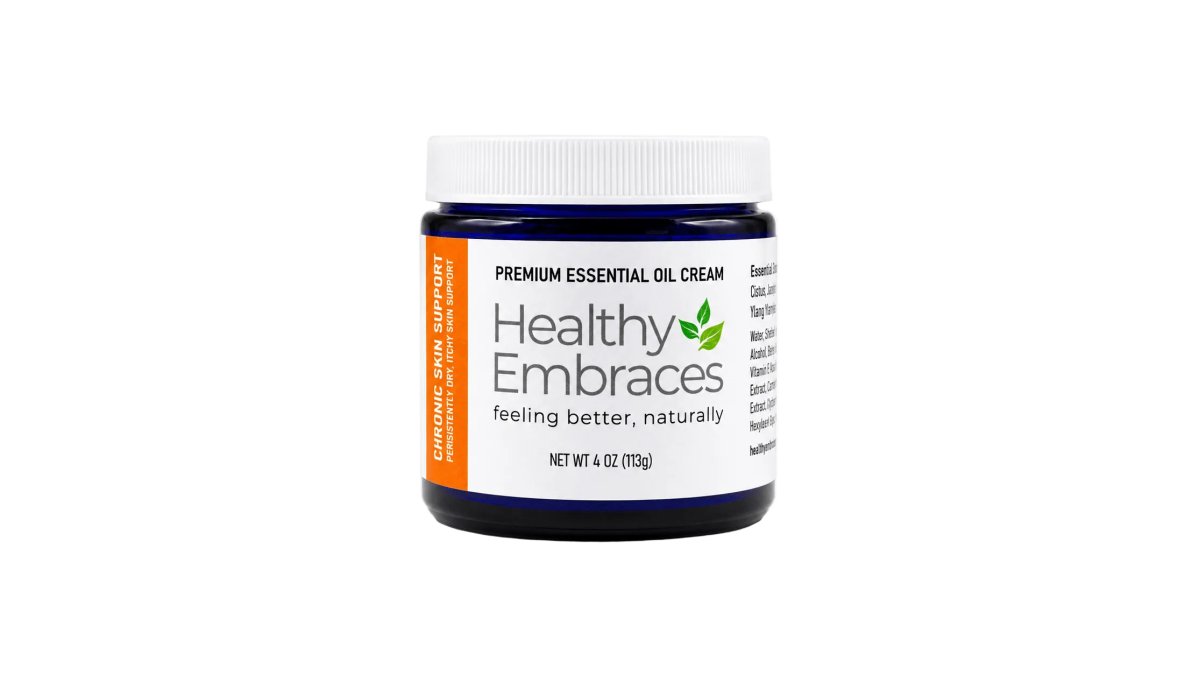
The right botanical cream depends on what your skin is doing. A formula for persistently dry, rough patches differs from one for itchy-feeling, reactive skin, and neither suits post-sun recovery or seasonal irritation. Healthy Embraces handcrafts each cream in small batches around a specific essential oil blend, so the choice comes down to matching the blend to the concern.
| Cream | Primary Concern | Key Botanical Blend | Best For | Price |
|---|---|---|---|---|
| Chronic Skin Support | Persistent dryness, rough patches | Cedarwood, Frankincense, Carrot Seed, Ylang Ylang | Long-term dry skin care | $26.95 |
| Soothe Cream | Dry, itchy-feeling, stressed skin | Cedarwood, Copaiba, Peppermint, Helichrysum | Reactive, uncomfortable skin | $26.95 |
| Skin Support Daily Comfort | Everyday dryness, changing weather | Lavender, Myrrh, Cistus, Copaiba | Daily maintenance | $26.95 |
| Allergy Support | Seasonal discomfort | Eucalyptus Blue Mallee, Lemon Myrtle, Goldenrod | Seasonal changes | $26.95 |
| Too Much Sun | Warm, overexposed-feeling skin | Peppermint, Birch, Turmeric, Black Pepper | After time outdoors | $26.95 |
The Best Botanical Lotion for Sensitive Skin: What to Look For
The best botanical lotion for sensitive skin has a short, transparent ingredient list, no synthetic fragrance, and a base of non-comedogenic plant oils rather than heavy occlusives. Sensitivity usually means the barrier is already compromised, so the goal is to support it, not layer more on top.

Look for these markers on the label:
- Cold-pressed oils rather than refined or hydrogenated versions, which retain more of their fatty acid profile.
- Hypoallergenic and dermatologist-tested language, ideally backed by a named testing standard.
- No added fragrance or essential oil overload. Some essential oils soothe at low dilution and irritate at high concentration.
- Non-greasy, absorbent bases. A formula that sits on the surface all day is harder to tolerate under clothing or on the face.
One thing most guides get wrong: "natural" does not automatically mean "non-irritating." Botanical extracts can trigger reactions just as easily as synthetic ones, and essential oil blends are among the more common culprits.
Why Your Skin's Microbiome Changes the Math
Most articles stop at surface hydration. The more useful question is what a cream does to the bacteria, fungi, and yeasts living on your skin, the microbiome, which helps regulate inflammation, barrier repair, and how easily irritants penetrate.
A few practical implications follow from that:
- Heavy occlusives can trap heat and moisture, shifting the balance of organisms on the skin surface. For most people this is harmless; for someone prone to folliculitis or fungal acne, a thick petrolatum layer can make things worse.
- Plant oils are not neutral. Coconut oil has documented antimicrobial activity; olive oil can feed malassezia yeasts in susceptible people. The effect depends on the oil, concentration, and individual.
- Preservatives cut both ways. Broad-spectrum preservatives keep mold and bacteria out of the jar, but a poorly preserved "natural" cream can introduce organisms onto compromised skin. Buy from a maker who can explain their preservation system rather than one who claims to be preservative-free.
- Essential oils are a double-edged input. At low dilution they calm reactive skin; at higher concentrations they disrupt the barrier and provoke contact dermatitis. "More botanical" is not automatically better for sensitive skin.
A common pattern: someone switches to a heavily fragranced botanical cream to avoid synthetic irritants, then reacts to the essential oil blend. The fix is not to abandon botanicals but to choose short formulas, low essential oil loads, and a base oil matched to your skin type.
Patch Testing and Shelf-Life: Two Things DIY Guides Skip
DIY skincare recipes rarely mention either, and both matter. Patch testing means applying a small amount to a discreet area, usually the inner forearm, and waiting 24 to 48 hours before broader use, the only reliable way to know how your skin will respond.
A workable protocol:
- Wash and dry the inner forearm.
- Apply a pea-sized amount to a small patch, about the size of a coin.
- Leave it uncovered and avoid washing the area for 24 hours.
- Check at 24 and 48 hours for redness, itching, swelling, or small bumps.
- If clear, repeat on a second patch near the jawline before using it on the full face.
If you are testing a product with essential oils, test the finished product rather than the individual oils, reactions often depend on the full formula, not a single ingredient.
Shelf-life is the other blind spot. Preservative-free and botanical-rich formulas have a shorter window than conventional creams, because plant oils oxidize and essential oils lose potency. Store creams away from direct heat and light, and treat any change in smell, color, or texture as a sign to stop using it. The FDA's guidance on cosmetic shelf-life and preservation explains why preservative-free products need more careful storage, not less.
Pricing Breakdown: What You Pay For in a Small-Batch Cream
A $26.95 small-batch cream and a $9 drugstore tube do not share a cost structure, and the gap is not pure margin. Here is where the money goes.
| Cost Driver | Drugstore Cream | Small-Batch Botanical Cream |
|---|---|---|
| Base ingredients | Mineral oil, petrolatum | Cold-pressed plant oils, botanical butters |
| Fragrance | Synthetic parfum | Pure essential oil blend |
| Preservation | Synthetic parabens and PEGs | Minimal or naturally derived preservation |
| Batch size | Mass production | Handcrafted in small batches |
| Testing | Standardized across batches | Per-batch quality checks |
| Shelf-life | Extended, sometimes years | Shorter, freshness-dependent |
The trade-off is straightforward: you pay for fresher raw materials, a transparent ingredient list, and smaller production runs, which means a shorter shelf-life and higher per-ounce cost. For sensitive or persistently dry skin, how the product feels and absorbs is usually the deciding factor. For a basic barrier cream, drugstore may be perfectly adequate.
Environmental Working Group's Skin Deep database is a useful independent reference for checking how individual ingredients rate for irritation and toxicity concerns.
Frequently Asked Questions
What are the most common synthetic ingredients to avoid in drugstore creams?
The ones worth checking first are parabens, synthetic fragrance (often listed simply as "fragrance"), mineral oil, petrolatum, and silicone-based ingredients like dimethicone. Fragrance is the leading cause of contact reactions in cosmetics, and because "fragrance" is a protected trade term, a single word can hide dozens of compounds. If your skin is reactive, look for creams that list every botanical extract and essential oil by name instead of grouping them under a catch-all term.
How can I tell if a skincare product is truly natural or just greenwashed?
Read the ingredient list, not the front of the label. Words like "botanical," "pure," and "dermatologist-tested" are marketing terms with no legal definition in the U.S. A genuinely plant-based cream names its oils and extracts individually, states whether it is paraben-free, and does not bury synthetic preservatives behind a "natural fragrance" claim. If the brand cannot tell you what is in the formula and why, treat the green imagery as decoration.
Are handcrafted botanical creams more effective for sensitive skin?
They can be, mainly because small-batch formulas tend to use fewer ingredients and skip synthetic fragrance, which is a frequent trigger for reactive skin. A cream built around emollients like copaiba balsam and soothing botanicals such as lavender or helichrysum supports the skin barrier without a long list of additives. Effectiveness still depends on your individual triggers, so patch test any new cream on your inner forearm for 24 hours before applying it to your face or neck.
How do small-batch skincare products differ from mass-produced drugstore items?
Mass-produced creams are formulated for a long shelf life, often two to three years, which usually means stronger preservative systems. Small-batch creams are made in smaller runs and are typically fresher when they reach you, but they have a shorter usable window, often 6 to 12 months after opening. Store them away from direct sun and heat, keep the lid closed, and check the batch date. Freshness is the trade-off for a shorter ingredient list.
Are natural alternatives to drugstore creams worth the higher price?
The price gap usually comes down to ingredient cost and batch size. Pure essential oils and cold-pressed botanical oils cost more per ounce than synthetic fragrance and mineral oil, and small-batch production does not benefit from the economies of scale that mass manufacturing does. Whether that is worth it depends on your priorities: if synthetic fragrance or parabens trigger your skin, the swap pays for itself in avoided reactions.