

How to Soothe Neck Tension: 7 Steps That Work
Table of Contents
- Why Neck Tension Builds Up: Common Causes
- Step 1: Apply Heat or Cold Therapy First
- Step 2: Neck Tension Relief Exercises That Work
- Step 3: Self-Massage Techniques for Knots
- Step 4: Ergonomic Fixes for Your Workspace
- Step 5: Essential Oils for Muscle Tension Support
- When to See a Doctor for Neck Pain
- Conclusion: Build a Daily Routine to Soothe Neck Tension
- Frequently Asked Questions
Last Updated: September 9, 2026
Neck tension is a stubborn, aching tightness in the muscles that support your head, often radiating into the shoulders and upper back. It is a widespread complaint among desk workers, and the discomfort can range from a mild nuisance to a source of tension headaches that disrupt your entire day. This guide walks you through a practical, step-by-step routine to soothe neck tension at home, combining heat therapy, targeted movement, and supportive self-care.
The most effective approach to how to soothe neck tension is not a single miracle fix but a layered routine: calm the immediate muscle spasm, restore range of motion, and address the daily habits that created the problem. This guide breaks down the approach into actionable steps, with the full routine taking about fifteen minutes once you learn the movements.
Why Neck Tension Builds Up: Common Causes
Most neck tension is a direct result of prolonged static posture. When you hold your head forward to look at a screen, the muscles in the back of your neck, particularly the trapezius muscle, work overtime to support its weight (peer-reviewed research). This sustained low-level contraction leads to muscle fatigue, stiffness, and eventually the formation of muscle knots, which are sensitive trigger points that refer pain to other areas.
Stress is a major accomplice. Stress-induced tension causes you to unconsciously hunch your shoulders and clench your jaw, placing further strain on the cervical spine. This creates a feedback loop: physical discomfort increases stress, which tightens the muscles further. Relief therefore requires both physical release and changes to your environment.
Step 1: Apply Heat or Cold Therapy First
Before you stretch or massage a tight neck, you need to prepare the tissue. For a dull, chronic ache that has been building for days, a warm compress or heating pad is the better first move. Heat increases blood flow to the area, which helps relax muscle fibers and ease general stiffness. You can use a warm, damp towel or a commercial heating pad for about fifteen minutes before moving on to other techniques.
Cold therapy is the right call for a recent acute injury or a sharp, sudden spasm, as it helps reduce muscle inflammation and numbs the area to break the pain cycle. An ice pack wrapped in a thin cloth applied for ten to fifteen minutes is sufficient. The American Academy of Orthopaedic Surgeons guidance on muscle pain notes that using either heat or cold can be an effective part of initial pain management, depending on the nature of the injury.
Step 2: Neck Tension Relief Exercises That Work
Once the muscles are warm, gentle movement is the most reliable way to restore function. These neck tension relief exercises are designed to improve your range of motion without aggravating the area. Move slowly and stop if you feel sharp pain; a mild stretch is normal, but a pinching sensation is a sign to back off. Perform this sequence once in the morning and once in the evening.
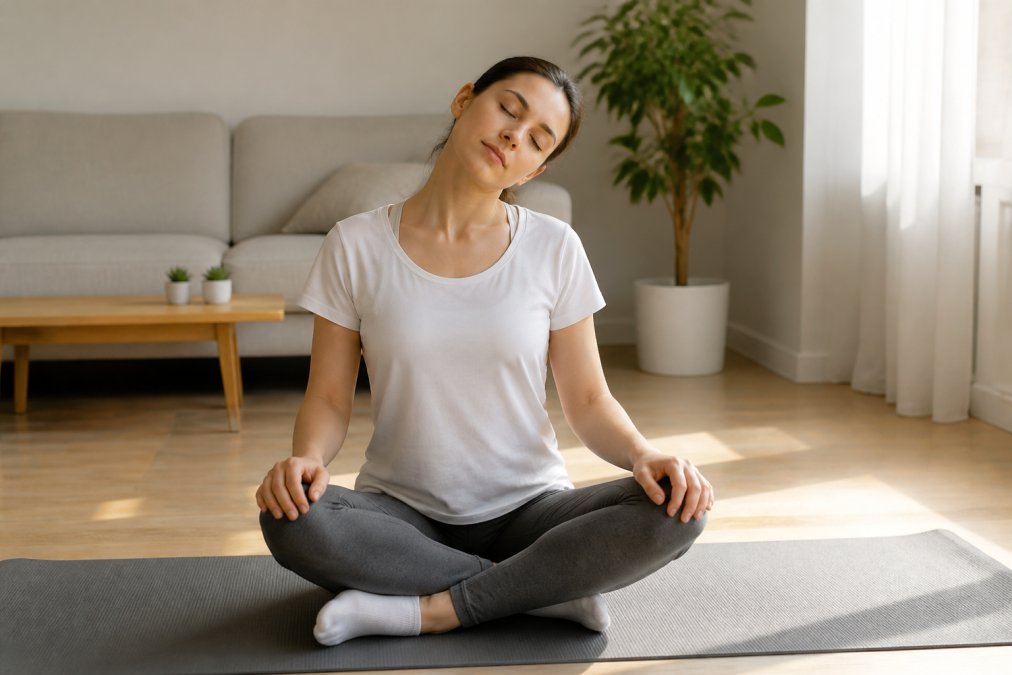
Gentle Stretches for Immediate Relief
Start with the side stretch. Sit tall with your shoulders down, then slowly bring your right ear toward your right shoulder until you feel a gentle pull on the left side of your neck. Hold for twenty to thirty seconds, breathing deeply, then repeat on the other side. Perform this twice per side.
Next, try the chin tuck to counter forward head posture. While sitting or standing, draw your chin straight back as if you are making a double chin, keeping your eyes level. Hold for five seconds and repeat ten times. This exercise strengthens the deep neck flexors and reinforces proper neck alignment, which is essential for long-term relief.
Mobility Drills to Restore Full Range of Motion
After the static stretches, move through these controlled mobility drills to lubricate the cervical joints and retrain your muscles to move through their full range.
- Slow Head Nods: Sit tall with your hands on your thighs. Slowly nod your head down as if saying "yes," bringing your chin toward your chest until you feel a gentle stretch. Return to neutral, then gently look up toward the ceiling without crunching the back of your neck. Repeat ten times, moving slowly with your breath.
- Side-to-Side Rotations: Turn your head to look over your right shoulder as far as is comfortable, then return to center and look over your left shoulder. Keep your shoulders relaxed and avoid lifting your chin. Repeat ten times per side.
- Shoulder Rolls: While sitting or standing, roll your shoulders backward in a slow, circular motion ten times, then reverse direction for ten more. This releases the trapezius muscles that attach at the base of the skull and often hold the bulk of tension.
Strengthening for Long-Term Resilience
Stretching alone won't prevent future flare-ups. Weak neck muscles force your upper traps to overwork, which is why tension keeps returning. Add these two isometric exercises to your routine three times per week.
- Isometric Side Press: Place your right palm against the right side of your head just above your ear. Press your head into your hand while resisting with your hand, so your head doesn't actually move. Hold for five seconds, rest, and repeat five times. Switch sides.
- Isometric Front Press: Place both palms against your forehead. Press your head forward into your hands while resisting, holding for five seconds. Repeat five times. This strengthens the deep flexor muscles that support your head in a neutral position.
A common pattern among desk workers is that the posterior neck muscles are overworked and tight while the anterior flexors are weak; balancing these two groups reduces the frequency of tension episodes. If any exercise causes dizziness, tingling, or radiating pain into your arm, stop immediately and consult a physical therapist.
Step 3: Self-Massage Techniques for Knots
Stretching alone often is not enough to break up stubborn trigger points. Self-massage targets those specific areas of tightness. The most accessible tool is your own hand: place your fingers on the muscle knot at the base of your skull or along the top of your shoulder, and apply firm, steady pressure in small circular motions for thirty to sixty seconds. relieve back muscle tension.
For a deeper effect, a tennis ball or a specialized massage tool can be placed between your shoulder blade and a wall, leaning in to apply pressure to the knot. This is a form of myofascial release that helps relax the contracted band of muscle. Following a massage, many people find that applying a botanical cream with warming or cooling properties extends the relief by keeping the area soothed as the muscles settle down. The National Institutes of Health overview on massage for pain suggests that massage therapy can be a useful component of pain management for many individuals.
Step 4: Ergonomic Fixes for Your Workspace
You can stretch and massage all you want, but if you return to a poorly set up desk, the tension will return within the hour. An ergonomic workspace audit is the most overlooked step in any plan to soothe neck tension. The goal is to keep your head balanced over your spine, not reaching forward. This section gives you a full audit checklist so you can identify exactly which element of your setup is causing your neck to work overtime.
The 90-90-90 Rule
Start with your chair. Sit fully back in your chair with your feet flat on the floor. Your knees should be bent at approximately a 90-degree angle, your hips at approximately 90 degrees, and your elbows at approximately 90 degrees when your hands rest on the keyboard. If your feet don't reach the floor, use a footrest. If your chair lacks lumbar support, place a rolled towel or small cushion at the small of your back to maintain the natural curve of your lower spine. When your pelvis is properly supported, your head naturally stacks over your shoulders.
Monitor Height and Distance
Your monitor is the single biggest contributor to forward head posture. Place the top bezel of your screen at or just below eye level. You should not tilt your head up or down by more than 15 degrees to see the center of the screen. Position the monitor approximately an arm's length away, roughly 20 to 28 inches. If you wear bifocals or progressives, lower the monitor an additional 1 to 2 inches so you don't tilt your head back to read through the lower portion of your lenses. For laptop users, the screen is almost always too low. Use a laptop stand to raise the screen to eye level, then connect an external keyboard and mouse so your wrists stay straight.
Keyboard and Mouse Placement
The keyboard should sit directly in front of you, not off to one side. Your wrists should be in a neutral, straight position, not bent up or down. If your keyboard has a number pad, consider a separate tenkeyless keyboard so the mouse can sit closer to your body, reducing shoulder abduction. The mouse should be at the same height as the keyboard. Reaching forward or out to the side for your mouse forces your shoulder blade to protract, which activates the levator scapulae muscle and creates tension at the base of your neck.
The Two-Hour Rule for Static Posture
Even a perfect ergonomic setup cannot overcome hours of uninterrupted stillness. Research on muscle fatigue shows that sustained static contraction, even at low intensity, reduces blood flow and triggers trigger point formation. Set a timer to stand up and move for two minutes every hour; the specific movement matters less than breaking the static load on your cervical spine.
Quick Self-Audit Checklist
Run through this list once per week. If you answer "no" to any item, fix it before your next work session.
- Top of monitor is at or slightly below eye level
- Monitor is approximately an arm's length away
- Feet rest flat on the floor without pressure on the backs of your thighs
- Lower back is supported by the chair back or a lumbar cushion
- Elbows are at approximately 90 degrees when typing
- Wrists are straight, not bent up or down
- Mouse sits at the same height as the keyboard and close to your body
- Shoulders are relaxed, not shrugged up toward your ears
- You stand and move for at least two minutes every hour
Step 5: Essential Oils for Muscle Tension Support
While physical techniques address the mechanical side of tension, topical botanicals can support the relaxation response. Using essential oils for muscle tension is a complementary practice that pairs well with massage. The act of touch itself helps signal your nervous system to calm down, and the aromatic compounds can enhance that effect.
Products like the Relax Cream from Healthy Embraces are formulated with pure essential oils to create a cooling, settling sensation that encourages physical ease. The non-greasy formula absorbs naturally, making it practical to use during the workday without leaving residue on your clothes. For a warming sensation that complements post-activity recovery, the Deeper Comfort Body Comfort Cream offers a blend designed to restore a sense of ease to overworked areas. These creams are not a replacement for medical treatment, but they are a pleasant way to extend the benefits of your stretching and massage routine.


When to See a Doctor for Neck Pain
While self-care resolves most cases of routine stiffness, you need to recognize when the problem is more serious. Consult a physical therapist or physician if the neck pain follows a fall or direct blow, if it is accompanied by numbness, tingling, or weakness in your arms or hands, or if it radiates down your arm, which could indicate nerve impingement.
Seek prompt medical attention if the pain is severe and comes on suddenly, or if it is accompanied by a headache, fever, or stiffness that prevents you from touching your chin to your chest. These can be signs of a more serious condition that requires professional diagnosis. Chronic pain that persists for more than a few weeks despite home treatment also warrants a professional evaluation to rule out underlying issues with the cervical spine.
Conclusion: Build a Daily Routine to Soothe Neck Tension
The key to lasting relief is consistency. A single session of stretching feels good for an hour, but a daily five-minute routine combined with an ergonomic setup will reduce your recovery time and prevent future flare-ups. This holistic approach addresses the muscle strain directly while correcting the habits that cause it.
At Healthy Embraces, we believe that everyday comfort comes from a combination of smart movement and supportive self-care. Our handcrafted, paraben-free creams are designed to complement your routine, providing a natural, cruelty-free way to encourage relaxation and restful sleep. Get started with Deeper Comfort Body Comfort Cream or Relax Cream and build a daily habit that keeps your neck feeling comfortable and supported.
Frequently Asked Questions
Can essential oils help soothe neck tension?
Yes. Essential oils like lavender, peppermint, and eucalyptus can help soothe neck tension when applied topically in a carrier cream. These oils work through scent receptors and skin absorption to encourage muscle relaxation. Look for products with pure essential oils rather than synthetic fragrances. Apply a small amount to the neck and shoulders, then massage gently. For best results, pair with stretching and heat therapy.
Why won't my neck tension go away?
Persistent neck tension usually stems from ongoing triggers rather than a single event. Common culprits include poor desk ergonomics, sleeping with inadequate pillow support, stress, and weak neck muscles. If tension persists after trying stretches, heat therapy, and massage for two weeks, consult a doctor. Chronic tightness can sometimes signal cervical spine issues or nerve impingement that needs professional assessment.
How does posture affect neck tension?
Poor posture directly increases neck tension. When your head drifts forward, the cervical spine supports extra weight, forcing the trapezius muscles to work harder. Over time, this creates muscle strain, stiffness, and knots. Fix your posture by positioning your monitor at eye level, keeping your shoulders relaxed, and taking breaks every 30 minutes. Consistent posture correction reduces the daily load on your neck muscles.
What is the pressure point to release neck tension?
The Jian Jing pressure point, located at the midpoint between your neck and shoulder, helps release tension in the trapezius muscle. Apply firm, circular pressure with your fingers for 30-60 seconds while breathing deeply. Another useful spot is the base of the skull, where the neck meets the head. Gentle myofascial release at these points can ease stiffness and improve range of motion.