

How to Identify Therapeutic Grade Essential Oils
Table of Contents
- What 'Therapeutic Grade' Really Means (And Doesn't)
- The Only Test That Matters: Understanding Your GC/MS Report Essential Oils
- How to Read Essential Oil Labels: 5 Details That Separate Pure From Pretenders
- 7 Adulterated Essential Oils Signs You Can Spot at Home
- Batch-Specific Verification: Why the Batch Number on the Bottle Matters
- What to Ignore: Marketing Claims vs. What Actually Verifies Purity
- How We Put Purity Into Practice: Our Transparency Promise
- Conclusion: Your Checklist for Choosing Verified Pure Oils
- Frequently Asked Questions
Last Updated: September 4, 2026
The term "therapeutic grade essential oils" is used so often it has nearly lost its meaning. No official regulatory body certifies an oil as "therapeutic grade," yet consumers pay premium prices based on that promise. This guide from Healthy Embraces shows you how to identify essential oils using verifiable evidence like lab reports, label details, and simple home tests.
Quality verification happens in the lab, not on the front label.
What 'Therapeutic Grade' Really Means (And Doesn't)
"Therapeutic grade" is a marketing term, not an official certification. No government agency, including the FDA, defines or regulates what makes an oil "therapeutic grade," so the phrase itself is unverifiable. The FDA does recognize certain oils as GRAS (Generally Recognized As Safe) for specific uses, but this status relates to food additives, not aromatherapy potency.
What the term attempts to convey is that an oil is pure enough to produce therapeutic effects when used in aromatherapy. The reality is that purity and quality are determined by measurable factors: the plant species, the extraction method, and the chemical composition verified through testing. As documented in FDA guidance on [essential oil(/blogs/healthy-embraces-blog/pure-essential-oil-creams-for-wellness-a-2026-guide) regulation | fda.gov], the agency does not evaluate essential oils for therapeutic claims, making third-party verification essential.
When a brand claims "therapeutic grade," it tells you nothing about the oil inside the bottle. What matters is whether the company can produce a Certificate of Analysis proving the oil's chemical profile matches expected standards.
The Only Test That Matters: Understanding Your GC/MS Report Essential Oils
Gas chromatography-mass spectrometry (GC/MS) testing is the gold standard for verifying essential oil purity and composition. A GC/MS report separates the oil into its individual chemical compounds, revealing both what is present and what should not be there.

How to Read the Key Sections of a Certificate of Analysis
A Certificate of Analysis (CoA) reports GC/MS results. Look for the chemical profile section, which lists major constituents with their percentages. For example, authentic lavender oil should contain linalool and linalyl acetate within expected ranges; significant deviations suggest adulteration.
The CoA should also state the botanical name, the plant part used, the country of origin, and the batch number. Cross-reference the chemical profile against ISO standards for essential oil quality or AFNOR guidelines, which define the expected composition ranges for specific oils. If a company cannot provide a CoA for the specific batch you are buying, that is a red flag.
How to Read Essential Oil Labels: 5 Details That Separate Pure From Pretenders
Reading essential oil labels means ignoring front marketing claims and focusing on the fine print. Five details reveal the truth about what is inside the bottle.
-
Botanical name: The label must list the exact Latin name, such as Lavandula angustifolia for true lavender. A label that only says "lavender" is too vague and may hide a cheaper species like Lavandula latifolia (spike lavender) or lavandin (Lavandula intermedia), both of which have different chemical profiles and lower market value. Cross-check the name against the USDA PLANTS Database to confirm the species is legitimate and not a hybrid or synonym.
-
Chemotype: Some plants produce different chemical profiles depending on growing conditions. A chemotype designation, such as Thymus vulgaris ct. linalool, tells you the dominant compound and its therapeutic properties. Without it, you cannot know whether you are getting a thymol-rich oil (stimulating, hot) or a linalool-rich oil (gentle, calming). For oils like thyme, oregano, or basil, the chemotype is the difference between a skin-safe oil and one that causes irritation.
-
Extraction method: Look for "steam distilled" or "cold-pressed," which preserve the oil's integrity. Avoid oils extracted with chemical solvents like hexane or ethanol, which leave residues. Carbon dioxide (CO2) extraction is acceptable and produces a more complete profile for delicate botanicals like ginger or frankincense, but it is more expensive. If the label does not state the method, assume it was solvent-extracted.
-
Plant part: The label should state whether the oil comes from the flowers, leaves, bark, or roots. Different parts yield different oils with different effects. For example, bitter orange (Citrus aurantium) produces three distinct oils: neroli from the blossoms, petitgrain from the leaves, and bitter orange from the peel, each with a different price point and therapeutic use. A label that omits the plant part may be blending parts to cut costs.
-
Batch number and date: A batch number allows you to trace the oil to its specific GC/MS report, while a distillation date confirms freshness. Oils degrade over time, citrus oils oxidize within 12 to 18 months, while woods and resins can last 5 years or more. The batch number should match the CoA you request; a report for a different batch leaves the oil in your hand unverified.
Check the label for the country of origin. The same species grown in different regions can have dramatically different chemical profiles. For example, Melaleuca alternifolia (tea tree) from Australia is the standard for quality, while tea tree grown elsewhere may have lower terpinen-4-ol content. Reputable brands list the country of origin because it affects the oil's chemistry.
Look for the distillation date, not just a "best by" date. Many companies only print a bottling date, which can be months or years after distillation. If the label shows only a bottling date, ask for the actual distillation date before purchasing.
A label that includes all five details, botanical name, chemotype, extraction method, plant part, and batch number, plus country of origin and distillation date, is designed for transparency. A label that omits these details makes verification harder than it needs to be.
7 Adulterated Essential Oils Signs You Can Spot at Home
While a GC/MS report is definitive, several physical signs can alert you to adulterated oils before you open the bottle. These home checks are not scientific proof, but they help screen out obvious fakes. Use them as a first-pass filter, then confirm with a batch-specific CoA.
-
Uniform droplet size: Pure oils vary slightly in viscosity and droplet behavior. If every drop is perfectly identical, the oil may have been cut with a carrier oil or synthetic thickener. Tilt the bottle at a 45-degree angle and let drops fall. Pure oils produce drops that vary in size and speed depending on natural viscosity; a perfectly consistent stream is a red flag.
-
Greasy residue: Place one drop on plain white paper and let it dry for 30 minutes. Pure oils evaporate with little to no residue. A greasy stain suggests carrier oils like jojoba or fractionated coconut oil. A translucent ring after 2 hours may indicate a lighter carrier like sunflower or grapeseed oil. For thicker oils like vetiver or sandalwood, compare against a known pure sample.
-
Instant absorption into skin: Pure oils absorb at different rates. If an oil labeled "pure" vanishes into the skin instantly, it may be diluted. Place one drop on the back of your hand and rub gently. Lavender and tea tree should absorb within 30 to 60 seconds. Heavier oils like patchouli or sandalwood may take 2 to 3 minutes. If a light oil absorbs in under 10 seconds, it has likely been cut with a fast-absorbing carrier.
-
Strong, linear scent: Pure essential oils have complex, layered aromas that evolve over time. A flat, one-note smell that disappears quickly often indicates synthetic fragrance. Place one drop on a scent strip. Smell it immediately, then after 5 and 30 minutes. A pure oil will shift, top notes fade, middle notes emerge, and base notes linger. A synthetic oil smells the same from start to finish.
-
Cloudy appearance: Most pure oils are clear. Cloudiness can indicate water contamination or poor filtration. Hold the bottle up to a bright light and look for haze, floating particles, or separation. Some oils, like myrrh or vetiver, are naturally thick and dark, but they should still be uniform. Two distinct layers or sediment indicate improper storage or blending.
-
Price that is too good to be true: Genuine oils like rose or jasmine require massive amounts of plant material to produce. A suspiciously cheap bottle is almost certainly adulterated. Reference points: 5 mL of pure rose otto typically costs $60 to $100; 5 mL of jasmine absolute runs $40 to $70; 5 mL of genuine sandalwood (Santalum album) is $80 to $120. If any of these are priced below $20 for 5 mL, it is either diluted, synthetic, or a different species.
-
Missing batch documentation: If the company cannot provide a CoA for the batch you are holding, assume the oil is not pure. A reputable supplier will share a CoA without requiring a purchase first. If the company says "we can send it after you order" or "our oils are all the same quality," that is a warning sign.
The Visual Identification Guide: What Pure Oil Looks Like
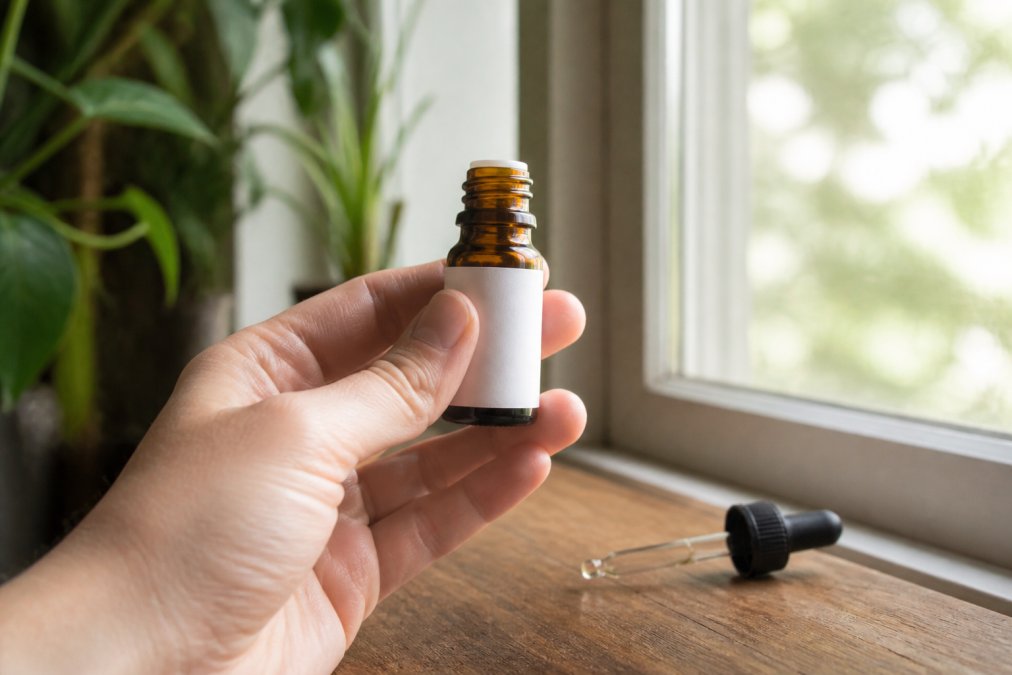
Pure essential oils are typically clear to pale yellow, though some, like patchouli or blue tansy, have deeper natural colors. Hold the bottle up to light and look for consistent color without floating particles or separation. The oil should be free-flowing unless its natural profile indicates otherwise.
Here is a quick visual reference for common oils:
| Oil | Expected Color | Expected Viscosity |
|---|---|---|
| Lavender (Lavandula angustifolia) | Clear to pale yellow | Thin, watery |
| Peppermint (Mentha piperita) | Clear to very pale yellow | Thin, watery |
| Tea Tree (Melaleuca alternifolia) | Clear to pale yellow | Thin, watery |
| Eucalyptus (Eucalyptus globulus) | Clear | Thin, watery |
| Frankincense (Boswellia carterii) | Pale yellow to light amber | Slightly thick, resinous |
| Patchouli (Pogostemon cablin) | Deep amber to dark brown | Thick, syrupy |
| Blue Tansy (Tanacetum annuum) | Deep blue to dark navy | Thin, watery |
| Sandalwood (Santalum album) | Pale yellow to golden | Slightly thick, oily |
| Vetiver (Vetiveria zizanioides) | Dark brown to amber | Very thick, syrupy |
If the color or viscosity does not match these expected ranges, be suspicious. A lavender oil that is dark amber has likely oxidized or been blended with a carrier. A peppermint oil that is thick and syrupy has been cut with vegetable glycerin or a heavy carrier oil.
The bottle itself matters too. Pure essential oils must be stored in dark amber or cobalt blue glass to protect them from UV light degradation. Clear plastic bottles are a sign that the company does not understand basic oil preservation. Check the orifice reducer, the small insert in the bottle opening, to ensure it is intact. A missing or loose reducer allows excess air into the bottle, accelerating oxidation.
These home tests are screening tools, not proof. The only definitive verification is a GC/MS report for the specific batch number on your bottle. Use these checks to narrow your options, then request the CoA before you buy.
Batch-Specific Verification: Why the Batch Number on the Bottle Matters
Essential oils are agricultural products, so their chemical composition varies from harvest to harvest. A batch number links your specific bottle to its own GC/MS report, not a generic "average" report.
Batch-specific verification tests each production run individually and publishes results for that exact batch. An oil that met quality standards in one season may fall short in another. Checking the CoA for your specific batch number confirms the oil you are using now meets the expected chemical profile.
Many reputable companies offer online databases where you can enter a batch number and pull up the corresponding CoA. If a company offers only a single generic report for all batches, they are likely hiding variability in their sourcing.
What to Ignore: Marketing Claims vs. What Actually Verifies Purity
The wellness industry is full of labels like "certified pure," "therapeutic grade," and "clinically proven" that sound authoritative but mean nothing without supporting data.
What actually verifies purity is a documented chain of evidence: the botanical name and chemotype, the extraction method, the GC/MS report for your specific batch, and compliance with recognized quality standards. As noted in research on [essential oil(/collections/all-products) adulteration and quality control | nih.gov], adulteration is a widespread problem in the industry, making independent testing the only reliable safeguard.
A brand that claims "therapeutic grade" but cannot produce a CoA is asking you to trust them blindly. A brand that provides batch-specific lab reports is demonstrating transparency through evidence. The latter is worth your money.
How We Put Purity Into Practice: Our Transparency Promise
At Healthy Embraces, we believe purity should be proven, not promised. Every product we create starts with 100% pure essential oils, sourced from suppliers who provide full GC/MS documentation for each batch we use.
We blend these verified oils into a clean, botanical lotion base that contains no parabens, phthalates, or synthetic fragrances. When you choose a product like our Breathe Easy Cream or our VN Stress Support Essential Oil Cream for Relaxation, you get the benefit of small-batch craftsmanship that prioritizes your wellness.

Our creams are made in small batches to ensure the oils retain their properties, and our non-greasy formulas absorb quickly for soothing, plant-based support throughout your day. For those seeking natural relief from muscle tension or daily stress, we offer a transparent alternative to products that hide behind vague marketing.
Conclusion: Your Checklist for Choosing Verified Pure Oils
Before you buy any essential oil product, ask for the botanical name, the chemotype, the extraction method, and the GC/MS report for the specific batch number on the bottle. If the seller cannot provide these, move on. The right product proves its purity through documentation, not just marketing language.
Finding genuinely pure oils takes a little more effort, but the payoff is real therapeutic benefit instead of diluted or synthetic disappointment. At Healthy Embraces, we make that effort for you by starting with verified oils and crafting them into fast-absorbing, botanical creams.
Choosing the right essential oil product is a matter of trusting evidence over adjectives. Healthy Embraces offers handcrafted essential oil creams that combine 100% pure essential oils with a clean, non-greasy base, free from parabens, phthalates, and synthetic fragrances. Our small-batch formulas absorb quickly to provide soothing relief for sore muscles, daily stress, and sensitive skin. Get started with Healthy Embraces and experience the difference of verified purity in every jar.
Frequently Asked Questions
Is 'therapeutic grade' a regulated term by the FDA?
No, the FDA does not define or regulate the term 'therapeutic grade' for essential oils. It is a marketing phrase created by a brand, not an official standard. Because the term is unregulated, any company can print it on a label. To verify actual purity, you must rely on objective evidence instead: a GC/MS report, the botanical name, and the absence of synthetic additives. Treat 'therapeutic grade' as a claim to investigate, not a certification to trust.
What specific information should be on an essential oil label?
A trustworthy label includes the plant's botanical name (like Lavandula angustifolia, not just 'lavender'), the chemotype if relevant, the country of origin, the extraction method (steam distillation or cold-pressed), a batch number, and the expiration date. If the label omits the botanical name or batch number, you cannot verify what is inside the bottle. A batch number is essential because it lets you request the GC/MS report for that specific fill.
How can I tell if an essential oil has been adulterated?
Look for the common adulterated essential oils signs: an unusually low price for the plant type, a missing botanical name, a missing batch number, and no available GC/MS report. At home, the visual test offers clues: pure oils evaporate without leaving a greasy residue, while oils cut with carrier oils or synthetics often feel slick. However, sophisticated adulteration can pass home tests, so a third-party GC/MS report remains the only reliable way to confirm the oil matches its label.
Why do some essential oils cost significantly more than others?
Price reflects the plant's yield and the extraction difficulty. For example, it takes about 250 pounds of lavender to produce one pound of oil, but roughly 10,000 pounds of rose petals for one pound of rose oil. A low price for an oil that is expensive to produce is a red flag for adulteration or dilution with a carrier oil or synthetic extender. If the price seems too good to be true, ask the seller for their GC/MS report before buying.
Are there industry standards for essential oil purity?
Yes, but they are voluntary, not government mandates. The International Organization for Standardization (ISO) and the French AFNOR guidelines both set specific chemical profiles for different plant species. A reputable supplier will test their oils against these standards and share the results. You can ask a brand if their GC/MS testing follows ISO or AFNOR criteria. A certificate of analysis that references these standards offers stronger assurance than a label claiming 'therapeutic grade.'
How do I know the essential oils in a product are actually pure and not just marketing hype?
Ask the brand directly for the GC/MS report for the batch number printed on the product. A company that uses genuinely pure oils will share this third-party testing document without hesitation. If they cannot or will not provide it, assume the claim is unverified. Look for products that list the specific essential oils used and their botanical names on the ingredient panel, which Healthy Embraces does for every cream we craft.
This article was written using GrandRanker