

Essential Oil Lotions for Sensitive Skin: A Safe Guide
Table of Contents
- Why Sensitive Skin Needs a Different Approach to Essential Oils
- Best Essential Oils for Sensitive Skin: What the Research Supports
- How to Dilute Essential Oils for Skin: Ratios That Protect
- Choosing a Paraben-Free Lotion Base That Won't Trigger a Reaction
- The Patch Test Protocol: Your First Line of Defense
- Signs of a Reaction and When to Stop Using a Product
- Common Mistakes That Cause Irritation
- Conclusion
- Frequently Asked Questions
Last Updated: September 7, 2026
Why Sensitive Skin Needs a Different Approach to Essential Oils
Sensitive skin is a condition characterized by a compromised skin barrier that allows irritants to penetrate more easily, triggering inflammation, redness, or stinging. This is why standard usage rates are too aggressive for reactive complexions, and why essential oil lotions for sensitive skin must prioritize dilution and ingredient transparency.
Most commercial lotions mask reactive symptoms with synthetic fragrance, which often makes the problem worse. The National Eczema Association guidance on irritants notes that fragrance is one of the most common triggers for people with sensitive or compromised skin. Healthy Embraces (Shopify) formulates small-batch botanical creams specifically to avoid these pitfalls, using pure essential oils and skipping harsh chemicals entirely. Below, we will show you exactly which oils are safe, which to avoid, and how to build a routine that protects your barrier rather than stressing it.
Best Essential Oils for Sensitive Skin: What the Research Supports
The best essential oils for sensitive skin are those with documented soothing and anti-inflammatory profiles, used at conservative percentages. Lavender, chamomile, and frankincense are widely recognized as gentle options, while citrus and spice oils carry a higher risk of sensitization and photosensitivity. The benefit comes from choosing the right molecule at the right dose.
- Lavender (Lavandula angustifolia): Known for calming properties and a low irritation index when properly diluted.
- Roman Chamomile (Anthemis nobilis): Contains esters that support soothing properties; ideal for redness-prone skin.
- Frankincense (Boswellia carterii): Offers grounding aromatherapy benefits with a gentle topical profile.
What most guides miss is that "therapeutic grade" is a marketing term, not a regulated certification. The real safeguard for sensitive skin is the dilution ratio and the purity of the carrier oil.
How to Dilute Essential Oils for Skin: Ratios That Protect
Learning how to dilute essential oils for skin correctly is the single most important step in preventing a reaction. For sensitive skin, the safe usage rate is 0.5% to 1% essential oil by total volume, or roughly 3 to 6 drops per 1 fluid ounce (30 mL) of lotion base.
| Dilution Strength | Drops per 1 oz (30 mL) | Best For |
|---|---|---|
| 0.5% | 3 drops | Sensitive skin, daily use, face |
| 1% | 6 drops | Normal skin, body lotion |
| 2% | 12 drops | Healthy skin, targeted areas |
A common mistake is assuming more drops equal faster results. Exceeding a 1% dilution for sensitive skin increases sensitization risk without adding therapeutic value. Always mix essential oils into a carrier first.
Choosing a Paraben-Free Lotion Base That Won't Trigger a Reaction
A paraben free lotion base is a good starting point, but not the only factor determining skin tolerance. Your base should also be free from synthetic fragrance, drying alcohols, and harsh preservatives like methylisothiazolinone, a known contact allergen. Look for simple formulations built on cold-pressed oils such as jojoba, sweet almond, or shea butter.
The emulsification and pH balance of your base matter as much as the absence of parabens. A lotion with a pH close to the skin's natural 4.5 to 5.5 supports barrier function. If buying a pre-made base, verify it is non-comedogenic and free from botanical extracts that may cross-react with your oils.
What Most Guides Miss: The Preservative Question in DIY Bases
If blending your own lotion from scratch, the most important safety consideration is not the essential oil, it is the water. Any water-containing base (hydrosols, aloe vera juice, or distilled water) breeds bacteria, mold, and yeast within days if left unpreserved.
A broad-spectrum preservative is required for any water-containing lotion that will be stored beyond a few days in the refrigerator. Common options include:
- Phenoxyethanol (0.5%-1%): Effective against bacteria and yeast, but not mold; often paired with ethylhexylglycerin.
- Leucidal Liquid (3%-4%): A plant-derived preservative system that is gentler for sensitive skin, though it has a narrower spectrum and shorter shelf life.
- Optiphen Plus (0.75%-1.5%): A paraben-free blend of phenoxyethanol and caprylyl glycol that covers bacteria, yeast, and mold.
For those with sensitive skin, the preservative choice itself can be a trigger. Phenoxyethanol is generally well-tolerated, but some report stinging at higher concentrations. If prone to reactions, choose a base that lists the preservative and its percentage, and patch test the base alone before adding oils.
Carrier Oil Chemistry: Matching Your Skin Type
The carrier oil in your lotion base is not an inert filler, it actively influences how your skin responds. For sensitive, reactive skin, select oils high in linoleic acid (omega-6) and low in oleic acid.
| Carrier Oil | Comedogenic Rating (0-5) | Skin Affinity | Best For |
|---|---|---|---|
| Jojoba (Simmondsia chinensis) | 0-2 | Closest to human sebum; non-greasy | Daily face and body use |
| Sweet Almond (Prunus amygdalus) | 2 | Lightweight, high in linoleic acid | General body lotion |
| Shea Butter (Butyrospermum parkii) | 0 | Rich in triterpenes; barrier-repairing | Dry, flaky patches |
| Grapeseed (Vitis vinifera) | 1 | Very light, high linoleic acid | Oily or combination sensitive skin |
| Coconut (Cocos nucifera) | 4 | High oleic acid; can clog pores | Avoid for face; use sparingly on body |
A common pattern is to blend two or three carriers, for example, 50% jojoba, 30% sweet almond, and 20% shea butter, to balance absorbency with barrier support. Avoid mineral oil and petrolatum in a base meant for sensitive skin; they do not provide the fatty acids a compromised barrier needs to repair itself.
pH and Emulsifier Stability
If using a pre-made lotion base, the emulsifier system determines how well the product holds together and interacts with your skin. Look for gentle emulsifiers like cetearyl olivate and sorbitan olivate, which are less likely to irritate than sodium lauryl sulfate-based systems. The final pH should fall between 4.5 and 5.5; test with pH strips, and if too alkaline, a few drops of lactic acid can lower it before adding oils.
For those who prefer not to formulate from scratch, the safest route is a pre-made, water-free base such as whipped shea butter or a jojoba-based serum. These require no preservative and eliminate water-related contamination risk. The trade-off is texture: water-free bases are richer and may not absorb as quickly.
FDA guidance on cosmetic preservatives and safety
Ultimately, the right base for sensitive skin is water-free or properly preserved, pH-balanced, non-comedogenic, and built on linoleic-acid-rich carriers. When you control these variables, the essential oil you add becomes the only remaining variable, and that is where your patch test protocol takes over.
The Patch Test Protocol: Your First Line of Defense
A patch test is the only reliable way to predict how your skin will react to a new blend before applying it to a larger area. Even with the best essential oil lotions for sensitive skin, individual responses vary, and a 48-hour test period can prevent a full-body rash.
- Apply a small amount of the diluted lotion to the inner forearm, just below the elbow.
- Cover the area with a bandage and leave it undisturbed for 24 to 48 hours.
- Do not wash the area during the test period.
- Check for redness, swelling, itching, or a burning sensation at the 24-hour and 48-hour marks.
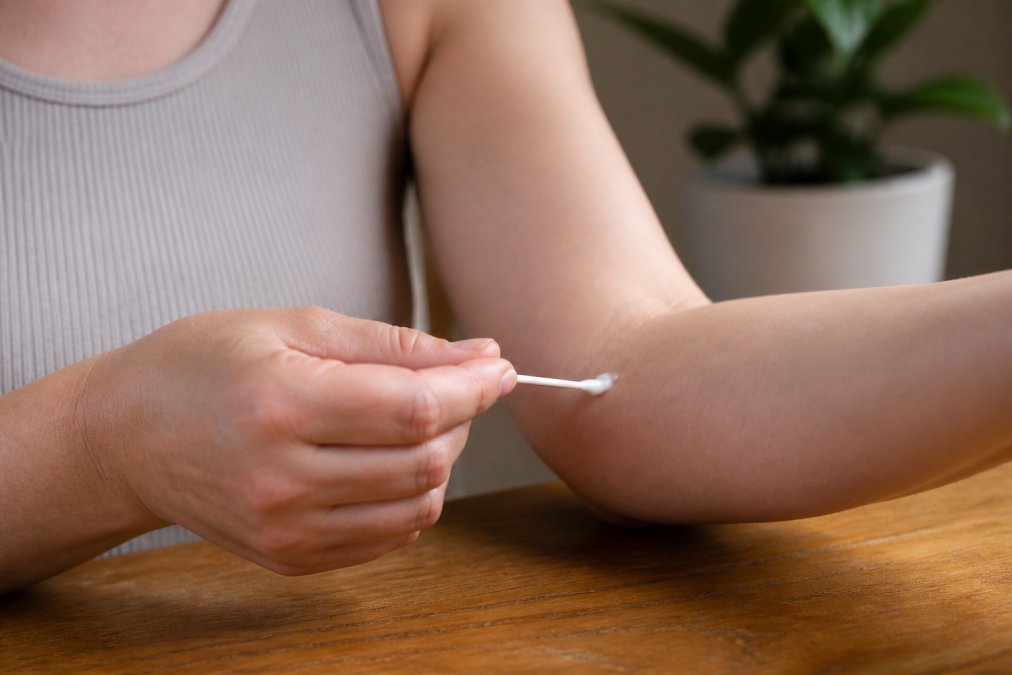
If no reaction appears after 48 hours, the blend is likely safe for broader use. If any redness or itching develops, wash the area immediately and discontinue use. For those managing chronic skin conditions like eczema, consult a dermatologist first.
Signs of a Reaction and When to Stop Using a Product
Recognizing early signs of an adverse reaction can mean the difference between mild discomfort and a prolonged flare-up. Contact dermatitis typically presents as redness, itching, or a raised rash, while a more severe reaction may involve swelling or blistering. If you experience burning within minutes, wash the area with mild soap and water right away.
The American Academy of Dermatology overview of contact dermatitis explains that allergic contact dermatitis can develop even after using a product successfully for weeks, as the immune system builds sensitivity over time. This is why rotating your routine and watching for delayed reactions matters. Stop using the product at the first sign of discomfort and allow your skin barrier to recover with a bland, fragrance-free moisturizer before trying anything new.
Common Mistakes That Cause Irritation
Several avoidable errors cause most essential oil-related flare-ups in sensitive skin: skipping the patch test, assuming a "natural" product is inherently safe, using essential oils at full strength for spot treatment, and layering multiple new products at once.
Another frequent issue is ignoring photosensitivity. Citrus oils like bergamot and sweet orange can cause a skin reaction when exposed to sunlight, even at safe dilution levels. If you use any citrus-based lotion, apply it at night or keep the area covered during the day. Also be cautious with expiration dates: oxidized oils are more likely to cause sensitization.
The Mistake Most Guides Miss: Ignoring Your Specific Skin Condition
Sensitive skin is not a single diagnosis, it is an umbrella term covering several distinct conditions with different triggers and tolerances. The essential oil lotion that calms one person's reactive skin may trigger a severe flare in someone managing a chronic condition.
Eczema (Atopic Dermatitis)
Eczema is characterized by a defective filaggrin protein, leaving the skin barrier leaky and prone to transepidermal water loss, so the skin absorbs essential oil constituents more rapidly and deeply than healthy skin. The National Eczema Association advises that fragrance, including natural essential oils, is a common trigger, and many dermatologists recommend avoiding essential oils entirely during an active flare.
If you have eczema and still wish to use an essential oil lotion, the safest window is during remission, not an active outbreak. When the skin is red, weeping, or cracked, apply only bland, fragrance-free emollients. During remission, a 0.5% dilution of lavender or chamomile in a high-linoleic carrier like jojoba may be tolerated, but you must patch test on an area that has previously had eczema lesions.
Psoriasis
Psoriasis is an immune-mediated condition that accelerates skin cell turnover, producing thick, silvery scales. Unlike eczema, the barrier is not necessarily leaky across the entire body, but the plaques themselves are highly vascular and can absorb topicals unpredictably. Some aromatherapy literature suggests anti-inflammatory oils like frankincense may soothe redness around plaques, but there is no clinical evidence that essential oils alter the underlying disease process.
A common mistake is aggressively exfoliating psoriatic plaques before applying lotion, which opens micro-tears and increases absorption of every ingredient. If you have psoriasis, apply essential oil lotion only to the surrounding skin, not directly to the plaque, and avoid warming oils like ginger or black pepper.
Rosacea
Rosacea is characterized by facial flushing, visible blood vessels, and papules, and it is uniquely sensitive to anything that causes vasodilation. Essential oils that are otherwise gentle, such as peppermint, eucalyptus, and even lavender in some individuals, can trigger an immediate flush because they stimulate blood flow near the skin's surface. The National Rosacea Society guidance on triggers identifies heat, spicy foods, and topical irritants as common triggers, and essential oils fall into that last category for many patients.
For rosacea-prone skin, the safest approach is to avoid essential oils on the face entirely and reserve them for the body, where the skin is thicker and less reactive. If you do use a facial lotion, choose a 0.5% dilution of Roman chamomile, which has cooling properties, and never combine it with other vasodilators like niacinamide at high percentages or alpha-hydroxy acids.
The Cross-Reactivity Mistake
Another overlooked error is cross-reactivity between essential oils and other botanicals in your routine. If you are allergic to ragweed, chamomile, a member of the Asteraceae family, may trigger a reaction even if you have used it safely before. Similarly, those with a birch pollen allergy may react to birch-derived salicylates in certain blends. If you have known plant allergies, review the botanical family of any essential oil before introducing it.
The "More Is Better" Dilution Mistake
A final mistake in clinical case reports is the belief that a 0.5% dilution is "too weak to work," leading users to double or triple the concentration and convert a soothing botanical into a sensitizing irritant. The therapeutic window is narrow: below 0.5%, most oils provide little measurable benefit; above 1% for sensitive skin, the risk of contact dermatitis rises sharply. More oil means more risk, not more benefit.
By understanding your specific condition and its unique triggers, you move beyond generic "sensitive skin" advice into a targeted approach that respects your skin's biology.
Conclusion
Building a safe essential oil routine for sensitive skin comes down to three principles: choose gentle oils, dilute them conservatively, and always patch test first. Many commercial options fail on at at least one of these fronts. Healthy Embraces (Shopify) formulates every cream in small batches using 100% pure essential oils, a paraben-free base, and a non-greasy finish.
Our cruelty-free formulas are designed for daily comfort, whether you need to calm muscle tension after a long desk day or unwind before sleep. If you have reacted to other "natural" products before, you will appreciate the short, readable ingredient list and the 90-day satisfaction guarantee. Explore the Healthy Embraces collection to find a botanical cream that supports your skin and well-being without compromise.
Frequently Asked Questions
What is the best essential oil for sensitive skin?
Lavender and chamomile are often the best choices for sensitive skin due to their soothing properties and low risk of sensitization. These oils are known for calming minor skin irritation and supporting the skin barrier. Always use a patch test first, even with these gentler options, and ensure they are properly diluted in a carrier oil or paraben-free lotion base.
What is a safe dilution ratio for essential oils in body lotion?
For sensitive skin, a 0.5% to 1% dilution is the safest starting point. This means adding 3 to 6 drops of essential oil per 1 fluid ounce (about 30 ml) of lotion base. Staying within this range minimizes the risk of skin irritation while still providing the benefits of the oil. For daily use, the lower end of this range is recommended.
Are essential oil lotions safe for daily use on sensitive skin?
Yes, but only when the product is properly formulated with a low dilution ratio and free from synthetic fragrance and harsh preservatives. A paraben-free lotion with a simple ingredient list is less likely to cause a reaction. Start by using the lotion once daily to observe how your skin responds before increasing frequency.
How do I know if my skin is reacting to an essential oil lotion?
Common signs of a reaction include redness, itching, a burning sensation, or a rash at the application site. These symptoms can appear immediately or develop over a few hours. If you notice any of these, stop using the product and wash the area with mild soap and water. Persistent or severe reactions warrant a consultation with a dermatologist.