

Best Essential Oil Creams for Sleep: 2026 Guide
Table of Contents
- Why Topical Essential Oil Creams Beat Pills for Sleep
- Quick Comparison: 7 Essential Oil Creams for Sleep
- The Benefits of Lavender Cream for Sleep and Evening Calm
- How to Apply Essential Oil Lotion for Relaxation
- Essential Oil Safety for Skin Application
- Creams vs. Diffusers vs. Sprays: Which Delivery Method Works Best?
- How to Build a Bedtime Routine Around Essential Oil Creams
- Conclusion
- Frequently Asked Questions
Last Updated: September 11, 2026
Why Topical Essential Oil Creams Beat Pills for Sleep
If you have ever swallowed a sleep aid and still stared at the ceiling, you understand the problem with pills. The best essential oil creams for sleep work differently: they deliver calming botanical compounds through your skin while you breathe in the aroma.
That two-path approach matters. The National Center for Complementary and Integrative Health overview of aromatherapy notes that inhaled plant aromas interact with the olfactory bulb, which connects directly to the limbic system, the part of the brain tied to emotion and relaxation. At Healthy Embraces, we built our entire line around that principle: pure essential oils blended into botanical creams you apply at bedtime.
Essential oil creams are topical lotions that combine pure essential oils with carrier ingredients, delivering relaxation support through both skin absorption and inhalation. Unlike a pill, a cream lets you control exactly where and how much you apply.
Below: seven creams worth your bedside table, how to apply them, and the safety steps most guides skip.
Quick Comparison: 7 Essential Oil Creams for Sleep
Every option below is a handcrafted, non-greasy formula, so the real differences come down to scent profile and purpose.
| Cream | Best For | Scent Character | Key Oils |
|---|---|---|---|
| Good Night Evening Relaxation Cream | Bedtime wind-down | Warm citrus and floral | Lavender, Bergamot, Ylang Ylang |
| Tranquil Relaxation Cream | Everyday stress | Herbal and grounding | Lavender, Frankincense, Cedarwood |
| VN Stress Support Cream | Overstimulated evenings | Citrus, floral, earthy | Frankincense, Bergamot, Tangerine |
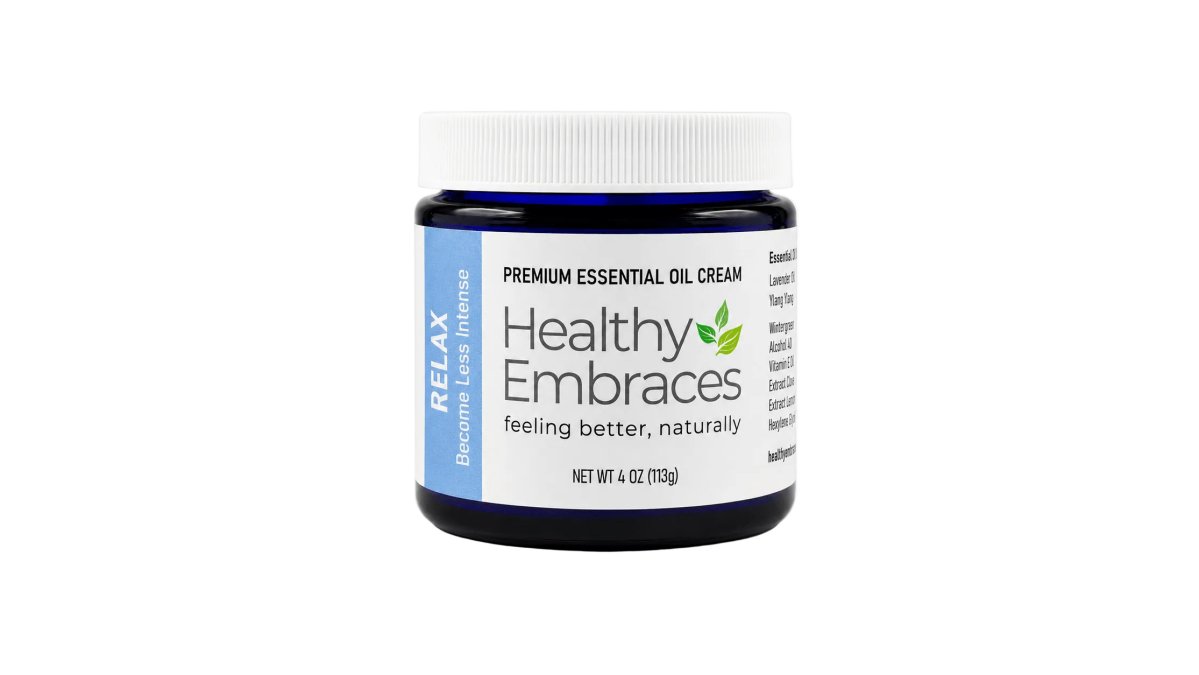
| Relax Cream | Muscle tension at night | Soft and cooling | Lavender, Botanical extracts |
| Nerve Support Cream | Hands, feet, legs | Cool and minty | Eucalyptus, Peppermint |
| Soothe Cream | Dry, sensitive skin | Gentle and calming | Lavender, Cedarwood, Chamomile |
| Deeper Comfort Cream | Post-activity recovery | Warming and woodsy | Balsam Fir, Black Pepper, Turmeric |
Our top pick for sleep is Good Night Evening Relaxation Cream. It was formulated specifically for the transition from "day mode" to "done."

The Benefits of Lavender Cream for Sleep and Evening Calm
Lavender earns its reputation honestly. In aromatherapy research, it is often the anchor oil in an evening blend, with supporting oils layered around it.
What Lavender Does for the Nervous System
Lavender's calming effect comes largely from linalool and linalyl acetate. Inhaled, those compounds reach the olfactory bulb within seconds, producing a "settling" sensation rather than drowsiness, which is why it pairs well with a bedtime ritual.
Lavender Paired With Other Sleep Oils
Lavender rarely works alone in a good formula. In Good Night Evening Relaxation Cream, it sits alongside Tangerine, Bergamot, Marjoram, Ylang Ylang, Frankincense, and Cape Chamomile: citrus lifts the scent so it does not feel heavy, while Marjoram and Frankincense add a grounding base.

How to Apply Essential Oil Lotion for Relaxation
Applying essential oil lotion for relaxation takes about 60 seconds, and technique matters more than amount.
- Warm a pea-sized amount between your fingertips for a few seconds.
- Apply to pulse points and tension areas: wrists, inner elbows, temples, and the back of your neck.
- Massage in slow circles for 20 to 30 seconds per area.
- Cup your hands near your face and inhale three slow breaths.
- Wash your hands if you applied near your eyes or plan to handle contact lenses.
Timing Your Application Before Bed
Apply your cream 20 to 30 minutes before you want to be asleep. That window lets the aroma settle and signals your body that wind-down has started; applying it right as you get into bed works, but you lose the ritual benefit.
How Much Cream to Use
A pea-sized amount covers both wrists; for shoulders or calves, use a nickel-sized amount. More cream does not mean more relaxation, and over-applying leaves residue on sheets, the complaint we hear most from people who tried oils and balms before.
Essential Oil Safety for Skin Application
Essential oil safety for skin application comes down to four things: dilution, carrier chemistry, patch testing, and knowing which oils commonly cause reactions.
Dilution: The Number That Matters Most
Undiluted essential oils should never go on skin. The standard range for a leave-on topical product is roughly 1% to 3% essential oil by volume, with 1% to 2% the common target for nightly bedtime creams, about 6 to 12 drops per ounce of carrier. Anything marketed as a "pure oil roller" or "neat" application is a spot treatment, not a leave-on sleep product.
A finished cream is already diluted for you, a practical advantage over mixing drops into lotion at home, where it is easy to overshoot.
Carrier Ingredients Do More Than Dilute
Carrier ingredients are not filler. They determine how fast the product absorbs, whether it leaves residue on sheets, and how much the essential oils sink in.
- Jojoba and squalane are close to skin's own sebum and tend to absorb quickly with little residue.
- Shea and cocoa butter are richer and slower, better for dry calves and elbows than for the neck.
- Fractionated coconut oil is light and stable but can feel slippery if overused.
- Alcohol-heavy gels and sprays evaporate fast, which is convenient for linens but drying on skin with repeated use.
A common pattern in reactions is not the essential oil at all, it is a fragrance additive, a preservative, or a botanical extract in the base. Read the full ingredient list, not just the oil list.
A Real Patch-Test Protocol
A patch test is not "put some on and see." Do it properly:
- Choose a low-stakes day. Not the night before a presentation or a flight.
- Wash and dry the inside of your forearm. Do not apply lotion, perfume, or sunscreen to that spot first.
- Apply a pea-sized amount and spread it over roughly a quarter-sized area.
- Cover it with a bandage so it stays put and does not rub off on clothing.
- Leave it for 24 hours. Do not peek and re-cover, leave it alone.
- Check at 24 and again at 48 hours. Redness, itching, swelling, small bumps, or a burning sensation all count as a reaction. Wash the area with mild soap and water and stop using the product.
- If clear, test the second product you plan to use the same way. Do not test two new creams on the same patch of skin at once.
A delayed reaction can show up on day two, which is why the 48-hour check matters. With eczema, psoriasis, or a known fragrance sensitivity, extend to 72 hours.
Sensitization vs. Irritation
These are different problems requiring different responses.
- Irritation is a direct reaction to something on the skin. It usually shows up quickly, burns or stings, and clears when you stop using the product.
- Sensitization is an immune response that builds over repeated exposure. You can use a cream for weeks with no issue and then develop a reaction. Once sensitized to a specific oil, citrus and certain floral absolutes are common culprits, you tend to stay sensitized, and future exposure can trigger a stronger response.
That is the argument for rotating products and for not layering five different essential oil creams on the same skin every night.
Oils That Commonly Cause Trouble on Skin
Some oils are fine to inhale but risky to leave on skin at higher concentrations:
- Cinnamon, clove, oregano, and thyme are hot oils. They are almost never appropriate in a leave-on bedtime cream.
- Bergamot and other cold-pressed citrus are phototoxic. Applied at night this is usually a non-issue, but avoid direct sun on treated skin the next morning.
- Peppermint and eucalyptus feel cooling and can be pleasant on feet and calves, but they sting near the eyes, on broken skin, and on sensitive areas.
- Tea tree is a common sensitizer with repeated leave-on use.
Medication and Medical Conditions
If you take sleep medication, sedatives, blood thinners, or any prescription drug, talk to your doctor before adding a topical essential oil product to your routine. Aromatherapy complements medical care, not replaces it, and topical products can interact with skin conditions and medications in ways a general article cannot predict.
FDA consumer guidance on cosmetics and topical products
Creams vs. Diffusers vs. Sprays: Which Delivery Method Works Best?
Most guides treat creams, diffusers, and sprays as interchangeable ways to "use essential oils for sleep." They are not. Each delivers the oils to a different place, at a different speed, for a different length of time, and the right choice depends on what is keeping you awake. herbal tea blends.
How Each Method Actually Delivers the Oils
Creams work through two paths at once. The carrier base holds the oils on the skin, absorbing gradually through the epidermis, while the scent rises off your wrists and neck to your olfactory system, a localized skin effect plus an inhaled effect, with the carrier slowing release.
Diffusers deliver almost entirely through inhalation. An ultrasonic diffuser vibrates water and oil into a fine mist that disperses through the room, reaching your nose within seconds, but also the walls, curtains, and your pets. Output depends on room size, ventilation, and water added.
Sprays are a hybrid. A linen or pillow spray puts oils onto fabric, where they off-gas slowly through the night. A body spray puts them on skin, but the alcohol or water base evaporates fast, so the effect is short and the dose hard to control.
Side-by-Side Comparison
| Method | Onset | Duration | Coverage | Best For | Main Drawback |
|---|---|---|---|---|---|
| Cream | 5-15 minutes | 2-4 hours | Targeted skin + personal scent bubble | Tense neck, shoulders, wrists; ritual anchoring | Requires application; some residue if over-applied |
| Diffuser | 10-20 minutes | 1-3 hours | Whole room | Filling a shared bedroom; scent while reading | Needs water and regular cleaning; can overwhelm small rooms |
| Pillow/linen spray | Immediate | 30-60 minutes | Fabric near your face | A quick scent cue at lights-out | Fades fast; can stain light fabrics; not for skin |
| Body spray | Immediate | 30-60 minutes | Broad skin area | A fast top-up on the go | Alcohol base can dry skin; hard to dose |
Why Creams Win for Localized Tension
If your problem is a tight neck, clenched jaw, or restless legs, a diffuser cannot help you, the oils are in the air, not on the muscle. A cream lets you put the product exactly where the tension is, and the massage motion itself, slow circles for 20 to 30 seconds, is part of the effect. That combination of scent, skin contact, and touch makes creams the most reliable single method for a bedtime routine.
Creams also win on control: you decide the dose, location, and timing, while a diffuser runs until you turn it off and a spray goes wherever the mist lands.
When a Diffuser Is the Better Choice
Diffusers make sense when you share a bed with someone who also wants the scent, when you want the whole room to feel different before you get in, or when you want to run something while you read. They are also the easiest way to test whether you like a particular oil before committing to a cream. The trade-offs: distilled water, cleaning every few days to prevent buildup, and strong output that can feel cloying in a small bedroom.
When a Spray Is the Better Choice
Sprays are best as a supporting cue, not a primary method. A few spritzes on the pillowcase five minutes before bed reinforce the scent association you have built with your cream. Keep them off your face, off skin if the base is alcohol-heavy, and off light-colored linens unless the label says otherwise.
The Combination Most People Land On
The strongest routine uses two methods for two jobs. A cream handles the targeted, personal, skin-level part of the wind-down; a diffuser or light pillow spray handles the room. That layering trains your body to associate the scent with bedtime, which is why the cream, not the diffuser, is the anchor.
How to Build a Bedtime Routine Around Essential Oil Creams
A bedtime ritual works because it is repetitive, not elaborate. Here is a simple structure that takes under 15 minutes.
- Set a consistent lights-down time and stick to it within 30 minutes
- Dim overhead lights an hour before bed
- Put your phone on Do Not Disturb and leave it outside the bedroom
- Apply your essential oil cream to wrists, neck, and any tense areas
- Inhale slowly for three breaths after application
- Do one quiet activity: reading, stretching, or light journaling
- Keep the room cool and dark
The cream is the anchor. Everything else supports it.
Conclusion
The hardest part of better sleep is not finding a product, it is building a routine you will actually repeat when you are tired and tempted to skip it. A cream makes that easier: one concrete action, under a minute, pairing a physical sensation with a familiar scent.
If you want a starting point, Good Night Evening Relaxation Cream was built for exactly this moment, with a blend of Lavender, Bergamot, Marjoram, and Cape Chamomile in a non-greasy, paraben-free formula. Every Healthy Embraces cream is handcrafted in small batches with pure essential oils, cruelty-free, and backed by a 90-day satisfaction guarantee.
Get started with Healthy Embraces and give your evenings a softer landing.
Frequently Asked Questions
What is the best essential oil blend for sleep?
Lavender is the most studied single oil for sleep, but blends tend to work better because they cover more of the wind-down process. A combination of lavender, bergamot, and frankincense targets both the calming and grounding sides of relaxation. Marjoram, ylang ylang, and Cape chamomile are common additions. When you shop, look for creams that list actual botanical names rather than the generic word fragrance, since synthetic fragrance does not carry the same therapeutic benefits.
Are essential oil creams effective for sleep?
Creams work through transdermal absorption and scent, not sedation. The essential oil compounds absorb through the skin and the aroma travels to the limbic system through the olfactory bulb, which is why a cream can shift your mood before your head hits the pillow. They will not knock you out the way a sleep aid does. Think of them as one part of a bedtime ritual that signals your body to slow down.
How do you use essential oil creams for better sleep?
Apply 15 to 30 minutes before bed to pulse points, the back of the neck, or the soles of your feet. Use a quarter-sized amount and massage it in until it absorbs. Pair it with dimmed lights and a consistent bedtime to reinforce the association. If you want a stronger effect, apply to your wrists and take three slow breaths with your hands cupped near your face before lying down.
Can essential oil creams interact with sleep medications?
Some essential oils, including lavender and chamomile, may add to the sedative effect of prescription sleep aids, anti-anxiety medications, or antihistamines. That does not mean you cannot use them, but it does mean you should talk to your doctor or pharmacist first, especially if you take anything daily. Start with a small amount and see how you feel before making it a nightly habit.
How do I patch test an essential oil cream for sensitive skin?
Apply a small amount to the inside of your forearm and cover it with a bandage. Leave it for 24 hours without washing the area. Check for redness, itching, or bumps when you remove the bandage. If nothing appears, the cream is likely safe for wider use. Repeat the test on your neck if that is where you plan to apply it, since skin sensitivity varies by body area.